


What It's Like going to Japan for Koi

By Tri-Star Koi
In January of 2024, I made my first journey to Japan to visit koi farms and learn about the origins of Nishikigoi. As someone deeply passionate about koi, this was more than just a business trip. It was a personal pilgrimage to the birthplace of the fish I’ve spent years studying and raising.

The trip began with a 16-hour flight from Nashville, Tennessee to Tokyo, Japan. Arriving in a new country where I didn’t know the language or the culture was overwhelming. But underneath that anxiety was excitement. I had finally made it to the heart of the koi world.
From Narita Airport, I boarded the Shinkansen to Tokyo Station. The speed of the bullet train was something to behold, and the changing scenery outside the window only added to the surreal feeling. Once I arrived at Tokyo Station, I purchased a second ticket for Nagaoka Station.

The further north we went, the colder it got. Snow began to blanket the ground and the crisp air was a clear sign we were entering the mountainous Niigata region, home to the most respected koi farms in Japan. It was around 8 p.m. when we arrived in Nagaoka. Most shops and restaurants were already closed for the night, but we managed to find a small local sushi restaurant. We enjoyed a quick warm meal and then called it a night. There was a long journey ahead of us.

The next morning, we were up at 4 a.m. After a simple breakfast, we picked up our rental car at 8 o'clock and began a three-hour drive to Isawa. Our first destination was Maruyama Koi Farm.Before visiting the farm, we met with Miwa, our local broker for the area. Brokers play an essential role in the koi buying process. They translate, negotiate, guide, and coordinate everything from farm visits to the eventual shipment of the koi back to the United States. Without them, the process would be nearly impossible.

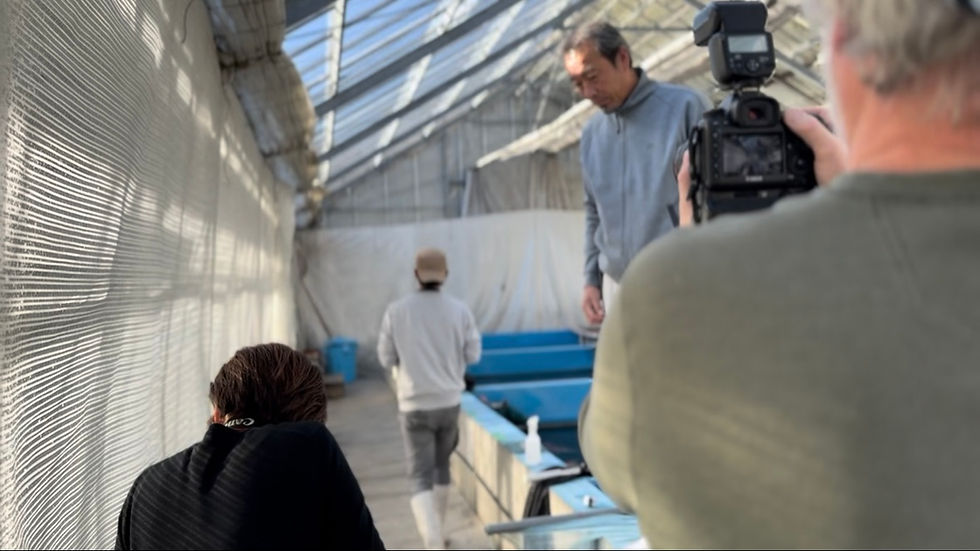
Miwa drove us to Maruyama Koi Farm, where we met Futoshi Maruyama. For me, meeting a breeder of this caliber in person was thrilling. We were handed a clipboard that listed the prices of koi in each tank. Around us were rows of blue tanks filled with beautiful Kohaku. Maruyama is best known for his Kohaku and Gin Rin Kohaku, along with Showa. Unfortunately, he had no Showa available that year, but his Kohaku more than made up for it.
After carefully reviewing several tanks, we decided to select from the fourth one, which had several promising jumbo tosai suitable for our clients.
We made our selections, confirmed the purchases with a handshake, and made the long trip back to Nagaoka. Since the overall trip would last 25 days, we had to be strategic with how we divided our visits across the schedule.Back in Nagaoka, we called it a night in preparation for the next day, which would take us to more historic farms.
Early the following morning, we drove to Ojiya, often considered the true birthplace of Nishikigoi. Our first stop was Torazo Koi Farm, where we were greeted by Homare Kawakami. Homare represents the new generation of the Kawakami family, who serve as brokers in both the Ojiya and Hiroshima regions. That day we were scheduled to visit both Marudo Koi Farm and Kanno Koi Farm. The Kawakami family made us feel right at home with their hospitality and knowledge of the region.
At Marudo Koi Farm, we explored tanks filled with Sanke and other Gosanke varieties. Several European dealers were also there selecting tosai, so we chose to examine a different tank. We were pleasantly surprised by the quality and variety we found. Marudo’s Sanke carried strong body lines and vibrant sumi, clearly influenced by the famous Matsunosuke bloodline.

After finishing at Marudo, we headed to Kanno Koi Farm, just a five-minute drive away. Kanno is a farm I’ve always admired for one reason Goshiki. This is one of my favorite varieties, and I’ve long respected the farm’s work. Meeting Kazuhiro Hirasawa, the owner of Kanno Koi Farm, was a surreal moment. You grow up seeing the koi he breeds in books and videos, but meeting him in person carries a different weight. There was a quiet presence about him that spoke volumes.
We selected from a mix of Kuro and Nezu Goshiki, giving us options for a variety of customer preferences. Before leaving, I made sure to take a picture with Kazuhiro and thanked him for the opportunity to visit his farm.

We returned to Torazo Koi Farm to regroup and discuss the remainder of the trip. I still hadn’t met Tsuyoshi Kawakami, the man behind Torazo’s legendary status. When he finally entered the office, I froze. This was someone who had produced top-tier Kohaku, Sanke, and Showa for decades. Meeting him was like meeting a celebrity you had followed your whole life.
He greeted us warmly, and we sat down to plan the next phase of the trip. We were served tea, coffee, and snacks as we reviewed the koi we had already purchased and discussed the specific varieties we still needed. Among those were Shiro Utsuri, more kawarigoi, and other less common types. Tsuyoshi and his family helped us map out which farms to visit on which days and how to group them for efficiency.

The next day, we had a full schedule ahead of us. We started the morning as usual—grabbing a quick coffee and heading straight to Torazo Koi Farm to pick up whomever was available to assist us on that day’s visits. This time, we were greeted warmly by Yuki Kawakami, the eldest daughter of Tsuyoshi Kawakami and the wife of Homare Kawakami. Yuki-san welcomed us with energy and enthusiasm. She would be accompanying us to Yamanaka Ohya Koi Farm and Teradomari Koi Farm, two breeders known for unique and eye-catching varieties. Our first stop, Yamanaka Ohya, was located just up into the mountains of Yamakoshi—not too far from our starting point. As we climbed higher, the landscape shifted to quiet, snow-lined roads and fog-draped pine trees. We soon arrived at the farm, where we were welcomed by Hideo Hishino, the owner and breeder behind Yamanaka Ohya Koi Farm.
Hishino-san is known for his work with unique and rare varieties, especially Aya Wakaba, Yamabuki Ogon, and other unusual "oddball" koi that don’t fit into mainstream categories. This visit was going to be perfect for clients who appreciate the unconventional.
Once inside the tosai greenhouse, I was stunned. Thousands of koi filled the tanks—colors I didn’t expect to see all in one place. Bright yellows, soft greens, deep blues, fiery reds, and vibrant oranges. It was a kaleidoscope of koi, and it felt like we had stepped into a painter’s studio.
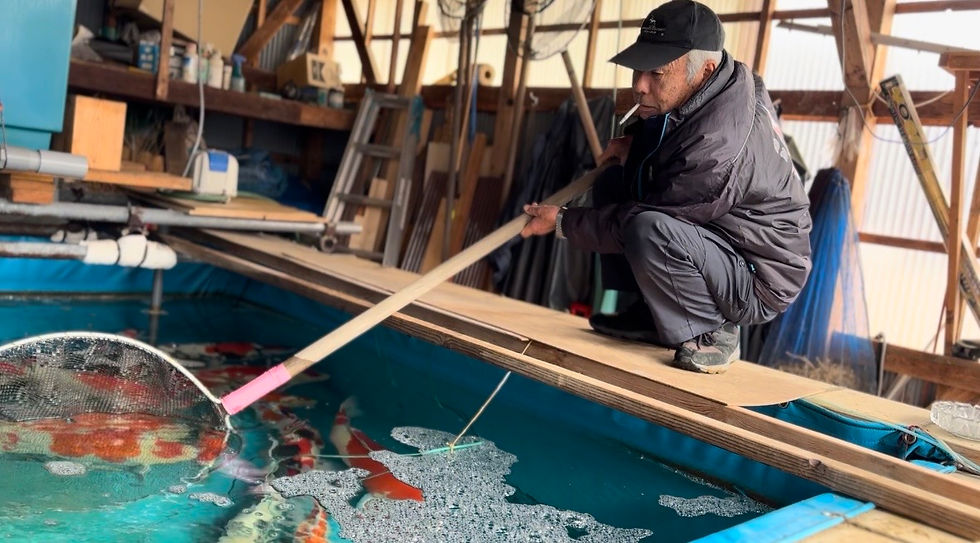
We selected an entire pond to seine, pulling a net through to gather up a group for closer inspection. As we sorted, we found some truly one-of-a-kind koi—fish with quirky patterns, rare colors, and unique body types. These weren’t your standard show koi, but that’s what made them special. They stood out. And for the right collector, they were treasures.
After finishing our tosai selections, Hishino-san took us over to the nisai greenhouse. There, we saw koi that had been raised from the previous year. The development and quality of these fish were impressive—bright skin, clean lines, and robust bodies. It was a privilege to see the progression from tosai to nisai in just one visit.

We didn’t have much time to spare. Our next appointment was a good distance away, so we thanked Hishino-san and began the journey to Teradomari Koi Farm. The drive to Teradomari took just over an hour. This breeder is well known for a very specific and refined specialty the “Teradomari Gin Rin.” It’s a signature look that the farm has built its reputation on, and one we were eager to explore. When we arrived, we were welcomed by Kiichi Hoshino, the owner of the farm. His excitement was clear. Being a smaller, more Speciality-style breeder, he was honored by the visit and had even prepared a special selection of tategoi for us in advance. These were hand-picked koi with exceptional future potential no need to sift through massive groups.

The koi he presented were stunning. Strong Gin Rin, luminous skin, and powerful bodies. Every fish looked healthy, vibrant, and full of character. You could tell he took pride in every one of them. Hoshino-san then invited us into another small greenhouse, this one housing some of his finest koi—sansai and yonsai fish that could easily turn heads at a high-level show. It was an honor to be shown these personally.

One of the great joys of visiting smaller farms like Teradomari is the level of intimacy and transparency. You see everything, and there are often hidden gems that larger farms might not even have time to highlight. The prices are often fair, and the breeders are more than happy to explain the lineage, feeding, and future expectations of each fish.
By the time we wrapped up at Teradomari, the day was winding down.
To end the visit on a high note, Yuki-san took us out to lunch at a local tempura restaurant. Like everything in Japanese culture, the meal was handled with care and precision. Every detail—from the crispy texture of the tempura to the softness of the rice—was executed perfectly. It was one of those quiet moments of appreciation, where you realize that everything here, even a simple lunch, reflects the same dedication and artistry that goes into breeding koi.

It was a long but fulfilling day. We had visited two farms that offered something completely different from the traditional Gosanke, and we left with a deeper appreciation for the variety and diversity that Japan’s koi breeders bring to the world.
Over the next couple of days, we decided to spread out our farm visits. This gave us time to evaluate which varieties our clients in the U.S. were responding to and plan selections accordingly. The next two farms on our list were Takahashi Koi Farm and Murata Koi Farm, both located in the Niigata Prefecture but on the farther edge of the region. Because of their distance, it made sense to pair them together in a single day’s itinerary.
We started at Takahashi Koi Farm, where we were greeted by Takehisa Takahashi, the breeder himself. He welcomed us with enthusiasm and was clearly eager to show off his selections from the year. As we walked around his ponds, I was immediately impressed. This was the first farm on the trip where we saw a strong showing of Doitsu varieties, which I had specifically been hoping to find for some of our clients.

Looking into the tanks, I knew this stop was going to be an expensive one as there were going to be alot I would want. There were so many koi that stood out instantly, each one more tempting than the last. After deciding on a pond to select from, the staff began presenting us with netfuls of tosai, one scoop at a time. It felt like being a kid in a candy shop, overwhelmed by choice and excitement.

One important thing to understand when buying koi in Japan is that each breeder can only fit a certain number of koi into a box for transport. If you overselect, you either need to buy more boxes or leave fish behind, so asking ahead about box capacity is essential. Fortunately, Takahashi-san was happy to walk us through that process.
Takahashi Koi Farm is best known for its Doitsu Gosanke, Beni Kumonryu, and Doitsu Kawarigoi. That reputation became evident quickly. The koi were stunning.

Their skin was glassy and vibrant, with purity and sharpness that can only come from strong bloodlines and careful cultivation. After completing our selections, I asked to take a photo with Takahashi-san as a keepsake. This was a farm I wouldn’t soon forget.

Next, we made the journey to Murata Koi Farm, a breeder with a singular focus on Kohaku. That is all Murata breeds, and his Kohaku are truly different. The beni on his koi has a signature elastic quality. It tightens and refines with age. Even more impressively, his bloodline is known for producing large, powerful fish. If you're looking for a Kohaku that will grow into a true giant, Murata is the name to know.
Shinji Murata, the breeder behind the farm, greeted us along with his wife. Their warmth and hospitality stood out immediately. We were invited into a heated greenhouse, and the moment we stepped in, we were surrounded by a sea of red and white. Kohaku after Kohaku, each with beautiful skin, balanced patterns, and promising structure.
Murata-san showed us the tank he had prepared for us to select from, and it did not disappoint.

As we sorted through the tosai, he offered insightful tips about how his bloodline develops over time. He pointed out subtle traits to look for, hints of how the koi’s skin or pattern might evolve over the next few years. These are the kinds of lessons you only learn by being there directly with the breeder. His advice helped shape the way we evaluated those fish, and looking back, it made all the difference in the quality of our selections.

Once we wrapped up the selection, Murata-san turned to us and smiled. Steak he asked. We couldn’t say no. He insisted on taking us to lunch, and we drove together to a small roadside steakhouse. When we walked in, Murata-san had already ordered for everyone. The meal, when it arrived, was stunning. A bento box was brought out, still sealed to keep it warm. When we opened it, we saw perfectly cut slices of Wagyu steak, arranged beautifully over a soft bed of rice, topped with a bright raw egg yolk. In traditional style, you break the yolk and mix it into the warm steak and rice.

The first bite was unforgettable. Rich, tender, savory. This was the kind of meal that defines a trip. One of those moments where flavor, company, and setting all come together to create something truly special.
After finishing, we thanked Murata-san and his wife for the incredible meal and their hospitality. It was time to head back to Nagaoka, where we would rest up and prepare for the remaining farms scheduled over the coming days.
During the last couple of days, we spread the remaining three koi farm visits across multiple days. We began by heading to the furthest destination first—Tanaka Koi Farm.
Tanaka Koi Farm is known for specializing in Hikari Muji and mono-variety koi. His standout varieties are Kin Showa and Hariwake, two types we were actively looking for. On the way to the farm, a blizzard rolled in. While driving along the freeway, a snowplow truck stopped us to let us know they needed to clear the roads ahead. That meant we had to contact the breeder and inform him we’d be running late.

When we finally arrived, Satoshi Tanaka of Tanaka Koi Farm greeted us warmly with a smile. His operation is quite small, but the quality of fish inside his greenhouse spoke volumes. The moment we stepped into the heated greenhouse, a burst of warm air hit us, and our attention immediately shifted to the tanks. There was a broad selection of varieties that we knew would be a hit with our clients back in the States.

Because we had two other appointments that same day, we kept the visit efficient. We made our selections, documented everything, and said our goodbyes. The quality was impressive, and we had no trouble building multiple boxes from his offerings.

Next, we made our way back to Ojiya for our appointment at Sakazume Koi Farm. Sakazume is well known for his Goromo, Hi Utsuri, and Platinum Ogon. When we arrived, Sakazume was in the middle of performing a water change. It was interesting to see how differently water changes are conducted in Japan compared to what we do at our own farm. Observing his methods gave us a chance to take back some valuable insights and techniques.
Once the water change was completed, we were invited into the greenhouse where multiple tanks were organized by client, variety, or general mix.

We didn’t want to take up too much of his time, so we selected a tank that had a good assortment of his more recognized varieties. Once netted, we picked through the koi and found a number of great selections that offered exceptional quality and value. We were happy with what we saw and what we could offer to our customers.

Every morning of the trip began at Torazo Koi Farm, so it only made sense to end our journey there too. But this time, we were scheduled for a final selection appointment.

We were led into the Tosai house. To reach the tanks, we had to climb a steep set of stairs, but the reward at the top made it worth the effort. Inside were tanks full of Kohaku and Tancho Kohaku with some of the silkiest, most refined skin we had seen the entire trip.

Torazo Koi Farm has a legacy of excellence in Kohaku, Gin Rin Kohaku, Sanke, and Showa. Their expertise spans multiple generations, and their experience is clearly reflected in the quality of their koi. As we began selecting, we were met with crisp-edged beni and porcelain-white shiroji.

These were exactly the kind of traits we had hoped to find.
Finishing our final selection was a bittersweet moment. We knew the trip was coming to an end, but I also knew it was only the beginning of many future visits. This was the start of a new chapter for our koi journey.

Before we left, we visited the office where we met with Tsuyoshi Kawakami and a group of American koi judges. It was incredible to connect with other koi enthusiasts from around the world. We shared stories, exchanged ideas, and enjoyed the camaraderie that comes naturally among people passionate about koi.
As our conversation wrapped up, it was time to say our goodbyes. The trip had officially come to an end, but the experience, the knowledge, and the relationships built would stay with us forever.

This was more than a buying trip. It was a deep dive into the heart of the koi world a journey that would shape how we understand, select, and share koi for years to come.
This first trip to Japan changed my view of koi forever. Buying koi directly from the source is not a simple process. It’s not just about picking out a fish and shipping it home. It’s about relationships, trust, and understanding the art behind every koi swimming in those blue bowls.
The knowledge I gained and the people I met on this trip helped shape how we at Tri-Star Koi approach everything we do. It was one of the most meaningful experiences of my life. I look forward to going back and sharing even more of Japan’s koi culture with the people who trust us to bring them something truly special.
-Marlon Ngo of Tri-Star Koi